As the business grows, managing operations becomes more challenging. Tracking inventory is done through spreadsheets, preparing financial statements takes several days, customer information is scattered on different systems, and employees spend much more time overcoming inefficiencies rather than achieving growth.
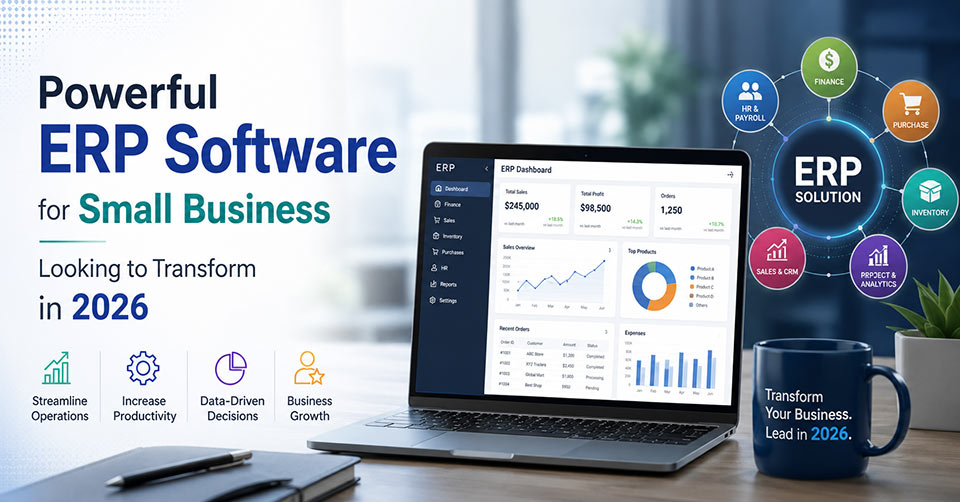
That is precisely why ERP software for small businesses is used. Contemporary ERP systems combine accounting, inventory management, procurement, customer management, financial reporting, and workflow into a single system, providing owners with full visibility over their operations at any moment.
In contrast to traditional ERPs, which demanded significant infrastructure investments and technical skills, modern ERP software is implemented quickly, is customizable, and significantly cheaper. Regardless of whether it is manufacturing or distribution, retail, or services, ERP has become an important competitive tool in 2026.
Why ERP Software For Small Business Is Growing Rapidly
Key benefits businesses are prioritizing:
| Business Needs | How ERP Helps |
|---|---|
| Financial visibility | Centralizes accounting and reporting |
| Inventory management | Tracks stock levels in real time |
| Faster decision-making | Provides live operational dashboards |
| Workflow automation | Reduces repetitive manual tasks |
| Scalability | Supports long-term business growth |
| Team collaboration | Connects departments in one system |
Modern Enterprise Resource Planning Software also gives leadership greater control over forecasting, procurement, and operational planning without relying on disconnected tools.
Best ERP Software for Small Business In 2026
Explore the top ERP solutions designed to simplify operations, improve efficiency, and support small business growth in 2026.
1. Oracle NetSuite
Best For: Scaling Businesses Requiring Advanced Automation
NetSuite still stands out as the best ERP software for small business. This platform integrates accounting, customer relationship management (CRM), inventory management, procurement, and reporting features to form a very scalable cloud-based ecosystem. The key advantage of NetSuite for businesses lies in its automation and real-time analytics capabilities that significantly cut down administrative work.
Features of the System:
- Financial management
- Inventory and order management
- Real-time dashboards
- Multi-site business management
Why Businesses Select This System: NetSuite is the best choice for companies that intend to grow aggressively.
2. Odoo
Best For: Flexible And Budget-Friendly Operations
Odoo has become very popular amongst small business enterprises due to its modular nature. The firm can begin with simple applications and add functionalities to suit the increasing complexity of the business processes.
Features:
- ERP system applications
- Manufacturing and inventory management
- Customer relationship management and e-commerce capabilities
- Workflow automation
Why Businesses Opt for Odoo: Its affordability and customization flexibility make it highly attractive for startups and growing operational teams.
3. Microsoft Dynamics 365
Best For: Microsoft-Centered Work Environments
Compatibility with Dynamics 365 with Microsoft Products like Teams, Outlook, Excel, and Power BI ensures that you have an easy working environment, along with analytical and business processes management skills.
Features:
- Artificial intelligence analytics
- Visibility into supply chain operations
- Sales forecasting
- Automation applications
Why Businesses Opt for Dynamics 365: For businesses that have invested in Microsoft software solutions, Dynamics 365 offers an easy transition and efficient integration.
4. ERPNext
Best For: Open-Source Flexibility
ERPNext provides robust ERP capabilities without the need for expensive licensing fees that come with other enterprise solutions.
Features:
- Customizable open source
- Human resource management
- Accounting software
- Manufacturing processes
- Project management
Why Companies Go For It: It represents excellent value for companies looking for affordable and flexible options.
5. SAP Business One
Best For: Manufacturing And Distribution Companies
SAP Business One was created to serve small enterprises that require sophisticated inventory, procurement, and production management capabilities, yet lack the sophistication of enterprise-level ERP systems.
Features:
- Supply Chain Management
- Production Planning
- Inventory Management
- Financial Reporting
Reasons Why Businesses Opt for SAP Business One: It is ideal for product-based companies dealing with intensive inventory operations.
ERP Comparison Table: Which Platform Fits Your Business
Here’s a quick comparison of leading ERP platforms to help you identify which solution best aligns with your business needs and growth stage.
| ERP Platform | Best For | Starting Pricing | Core Strength |
|---|---|---|---|
| Oracle NetSuite | Scaling businesses | Custom pricing | Advanced automation |
| Odoo | Startups and SMBs | Affordable modular pricing | Flexibility |
| Microsoft Dynamics 365 | Microsoft-based businesses | Custom pricing | Integration ecosystem |
| ERPNext | Budget-conscious companies | Open-source | Customization |
| SAP Business One | Manufacturing and distribution | Custom pricing | Operational control |
How To Choose The Right ERP System
Choosing the right ERP system requires careful evaluation of your business needs, scalability requirements, and operational goals to ensure long-term efficiency and growth.
ERP Selection Checklist
Selection of ERP software involves more than a simple evaluation of features. The software should be assessed based on its compatibility with current processes, projected future growth, and user-friendliness.
| Evaluation Area | Why It Matters |
|---|---|
| Ease of use | Improves employee adoption |
| Integration support | Prevents disconnected workflows |
| Scalability | Supports future expansion |
| Reporting capabilities | Enables faster decisions |
| Industry specialization | Improves operational efficiency |
| Total implementation cost | Prevents budget overruns |
| Customer support quality | Reduces operational downtime |
The main reason behind ERP failures among many organizations is that they adopt systems made for large companies instead of those compatible with their own processes.
The Rise Of Cloud ERP Adoption
The shift toward Cloud based ERP software for small business environments continues to grow because cloud systems eliminate many of the barriers traditionally associated with ERP implementation. Cloud-based ERP platforms provide smaller organizations with a much easier route to digital transformation.
Final Comparison Snapshot
| If Your Business Needs | Recommended ERP |
|---|---|
| Manufacturing management | SAP Business One |
| Operational scalability | Oracle NetSuite |
| Budget flexibility | ERPNext |
| Microsoft integration | Dynamics 365 |
| Modular customization | Odoo |
Conclusion
Selecting the right ERP solution is not just an IT consideration; it is a strategic move towards efficiency, scalability, and stability for your organization. In light of the increasing operational complexity for small enterprises, it has become necessary to adopt a centrally managed system to ensure visibility, accuracy, and control over their day-to-day activities.
The best ERP software products are those which streamline operations while offering scope for future growth without any additional hassles. Irrespective of whether the objective is better stock tracking, improved financial management, workflow automation, or increased accuracy in reporting, the ideal ERP solution can prove invaluable for your company.
As you evaluate ERP implementation options for 2026, consider usability, scalability, integrability, and operational relevance as important factors.
Frequently Asked Questions
1. What is ERP software used for in small businesses?
It helps small businesses manage finance, inventory, sales, and operations in one centralized system, improving efficiency and reducing manual work.
2. How does best ERP software for small business improve daily operations?
It streamlines workflows by automating repetitive tasks, improving reporting accuracy, and giving business owners real-time visibility into operations.
3. What makes Cloud based ERP software for small business different from traditional systems?
Cloud-based systems run online, allowing access from anywhere, automatic updates, lower infrastructure costs, and easier collaboration across teams.
4. Is ERP suitable for startups and growing companies?
Yes, modern ERP solutions are designed to scale, meaning startups can start with basic features and expand as their business grows.
5. Do small businesses need technical skills to use ERP systems?
Most modern platforms are user-friendly with guided setups and dashboards, so even non-technical users can manage daily operations effectively.