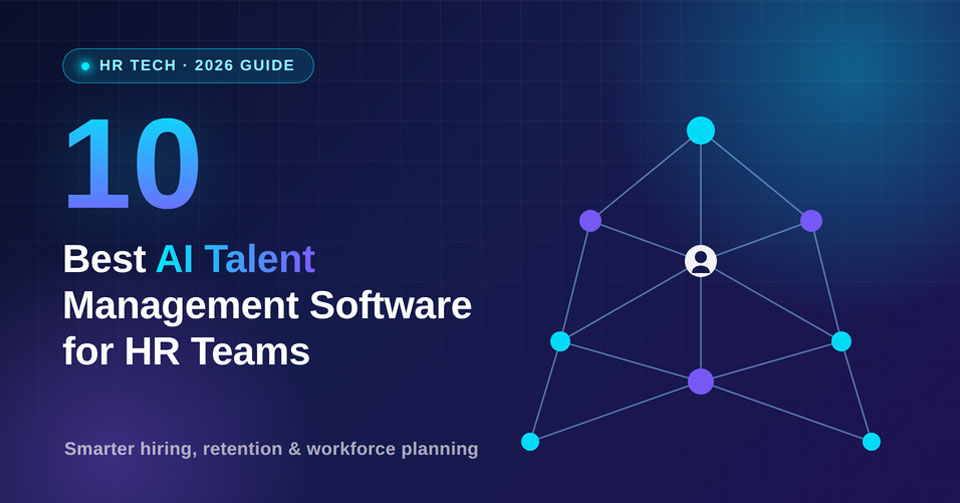
Artificial intelligence is reshaping the way organizations hire, develop, and retain employees. From screening candidates faster to identifying future leaders and personalizing employee development, AI has become an essential part of modern HR strategies. Instead of spending hours on repetitive administrative work, HR professionals can use intelligent tools to make faster, data-driven decisions while creating better employee experiences.
This guide explores the best AI talent management software solutions for 2026, highlighting their strengths, key capabilities, and the types of organizations they suit best.
What Is AI Talent Management Software?
AI talent management software employs artificial intelligence, machine learning, and predictive analysis to optimize all phases of the employee life cycle. These systems enable HR departments to automate the process of recruiting people, recognize trends within the workforce, evaluate employee performance, facilitate personal development, and conduct succession planning.
AI does not replace HR personnel but serves as a tool enabling them to make better-informed choices regarding recruitment, team building, and minimizing employee turnover.
Advantages of AI Talent Management Software
Organizations have begun to use AI-based HR software due to efficiency and employee experience improvements. Some of the benefits include:
- Quick candidate selection and recruitment
- Manual HR tasks reduction
- Hiring based on skills
- Employee training recommendations
- Enhancing engagement of employees
- Predictive retention insights
- Performance management through data
- Succession planning improvement
- Informed decision making about workforce
Top AI Talent Management Software for HR Teams
Enterprise Workforce Management
Big companies require applications that will allow them to control their difficult HR processes in different departments. Workday is famous for its integration of AI-based recruiting, workforce planning, skills intelligence, and internal mobility all in one application. This allows HR managers to find the gaps in their personnel, provide suggestions about career paths, and make workforce decisions through real-time analytics.
SAP SuccessFactors is another solution that incorporates AI into recruiting, onboarding, employees’ development, learning management, and performance evaluations. Personalized recommendations and insight into workforce make it a good option for organizations that have big teams.
HR Automation
Automation has become one of the major benefits of HR technology in recent times. Oracle Fusion Cloud HCM automates the process of recruitment, employee onboarding, workforce planning, and other processes through its AI-enabled analytics. It also has a digital assistant which cuts down the workload.
Increasing organizations can also leverage the power of Darwinbox as it integrates AI-powered recruitment, employee engagement, leave management, performance management, and workforce analytics through its advanced interface. Through automation, HR personnel can dedicate more of their time towards helping their employees rather than paperwork.
Skills-Based Hiring and Internal Mobility
Many companies are shifting away from their traditional hiring techniques and concentrating more on the skills of their employees. Eightfold AI is a talent intelligence company that analyzes employee competencies, finds skills and matches candidates for suitable openings. The AI even suggests career paths that ensure better employee retention.
One such platform is Phenom, which makes recruiting and internal mobility easy through personalized job recommendations, intelligent career websites, and smart candidate engagement techniques.
Employee Learning and Development
Employee development is as essential as recruiting employees. Cornerstone Talent Management relies on AI to suggest personalized learning materials, assess skill gaps, and ensure that the employees keep growing. The managers can track the development process and make sure that learning is aligned with organizational goals.
Learning recommendations that are provided by AI would allow employees to develop necessary skills, and, at the same time, provide important data regarding their workforce competency to HR managers.
Recruitment and Talent Acquisition
Effective recruitment is more than just the act of hiring people but is about building strong relationships with the right talent. One such tool is Beamery, which helps organizations create strong pipelines due to their candidate matching and recruitment automation capabilities.
The smart automation technology ensures proper communication during the recruitment process.
Managing Global Workforces
Organizations that operate in several countries have extra HR hurdles, including onboarding, compliance, visibility of their workforce, and management of the employees. UKG Pro combines workforce management, employee engagement, predictive analysis, and development of talents to aid HR teams to manage their distributed workforce better.
For organizations that hire globally, Fuel50 makes the management of their global workforce easy through its AI-powered onboarding process, skill management, employee development, and HR automation capabilities.
How to Choose AI Talent Management Software
Not all software has the same capabilities; that is why the selection criteria should be based on the requirements of the company. Here are some considerations for selecting the best AI talent management software:
- Size of the company and future plans for expansion
- Number of hires and recruitment complexity
- Learning and development needs
- Automation capabilities using AI
- Analytics and reporting
- Performance management capabilities
- Compatibility with current HR systems
- Security and compliance considerations
- Ease of implementation
- Scalability
Future of AI-Talent Management Software
AI talent management software has continued evolving and has been helping HR departments in progressing from automation to strategic workforce management. The new trends in the area have included skills-based hiring, retention prediction, AI career coaching, personalized learning, AI assistance in generating content, and intelligent succession management. All this has enabled firms to make more sound decisions while promoting employee development and engagement.
With continuous advancement in technology in these fields, AI will be playing an even bigger role in the future of HR. Whatever your needs may be in terms of recruitment, development of your employees, planning for your workforce, or managing global workforces, use of the appropriate AI talent management software will put you ahead of the game.
Frequently Asked Questions
What is AI talent management software?
AI talent management software uses artificial intelligence to improve recruitment, employee development, performance management, workforce planning, and talent retention through automation and data-driven insights.
Can small businesses use AI talent management software?
Yes. Many AI-powered HR platforms offer scalable features that support startups and small businesses while allowing them to expand as their workforce grows.
How does AI improve talent management?
AI automates repetitive HR tasks, analyzes workforce data, recommends learning opportunities, predicts employee turnover, and helps HR teams make faster, more informed decisions throughout the employee lifecycle.
What should businesses consider before choosing AI talent management software?
Businesses should evaluate AI capabilities, scalability, ease of use, integrations, security, reporting features, employee experience, implementation support, and long-term return on investment before selecting a platform.