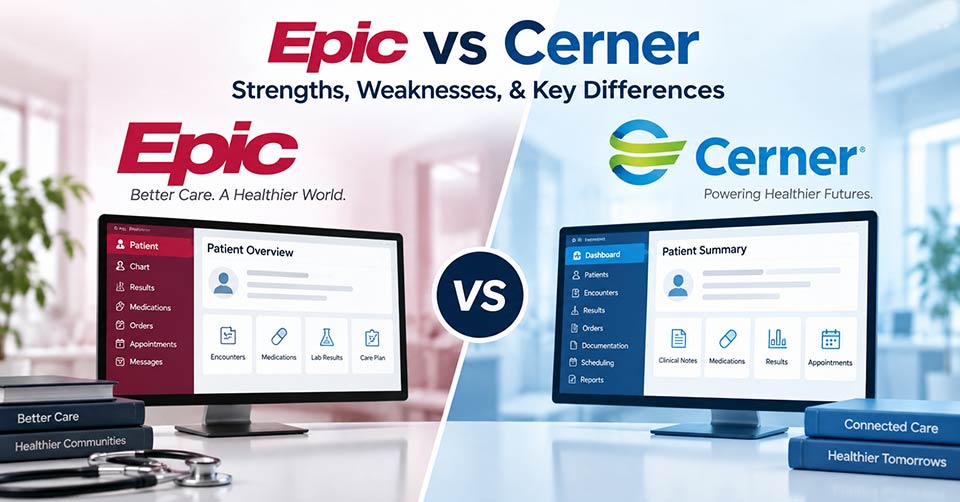
It can take months for healthcare systems to assess Epic vs Cerner, given how the choice influences workflows, billing, training, and operational performance. Definitive Healthcare data shows Epic leading U.S. hospital EHR adoption, with Cerner ranking second. Priorities aren’t the same for everyone; some focus on interoperability, others on usability and dependable support. Although the comparison is technical, choices usually come down to everyday workflow requirements.
Epic vs Cerner: Understanding the Two EHR Systems
Epic is a large scale healthcare management platform used for electronic medical records, patient coordination, billing, and clinical documentation. It is often selected by major healthcare systems looking for a unified platform with strong reporting and integration capabilities. Its connected system structure also supports smooth data sharing and communication across departments through integrated interoperability features.
On the other hand, Cerner, now part of Oracle Health, is an EHR system used in hospitals, clinics, and healthcare networks for organizing patient data, billing activities, and clinical workflows. It is often considered suitable for large scale and interoperable healthcare environments.
Comparing the Core Features of Epic and Cerner
Differences in workflow and system design can affect usability and outcomes, making it important to evaluate any EHR or EMR software carefully before choosing.
| Epic | Cerner |
|---|---|
| EHR system for managing patient records across care settings | EHR system used for patient data management across healthcare organizations |
| Integrated clinical documentation tools for physicians and care teams | Clinical documentation tools supporting inpatient and outpatient workflows |
| Built in scheduling system for appointments and resource management | Scheduling tools for patient appointments and clinical coordination |
| Revenue cycle management tools for billing, coding, and claims workflows | Revenue cycle management supporting billing, claims, and financial operations |
| Patient portal (MyChart) for patient access and communication | Patient portal solutions for patient engagement and access to health records |
| Interoperability support through Epic Care Everywhere for data exchange between organizations | Interoperability capabilities supporting data exchange across systems and providers |
| Reporting and analytics tools for clinical and operational insights | Reporting and analytics tools for healthcare data and performance tracking |
| Population health management tools for group level patient care insights | Population health management capabilities for care coordination and outcomes tracking |
| Integrated workflows across modules within a single platform ecosystem | Modular system structure that supports integration with external healthcare systems |
| Decision support tools to assist clinical workflows | Clinical decision support features to support care delivery and operations |
Strengths and Weaknesses of Both Systems
To make an informed choice, it helps to examine where each healthcare platform excels and falls short.
Epic
| Strengths | Weaknesses |
|---|---|
| Enables tight integration across labs, departments, and care teams, ensuring smooth and consistent internal data flow. | High overall cost for licensing, deployment, and ongoing maintenance, making it less accessible for smaller providers |
| Patient engagement tools like MyChart allow users to manage appointments, view results, and communicate with providers easily | Requires extensive training due to its complex interface and large number of features |
| Wide range of clinical, billing, and administrative modules supports multiple specialties within one platform | The system’s workflow structure may feel less flexible, especially for users who prefer adaptable processes |
| Regular internal updates improve system performance, features, and compliance support over time | Implementation process is lengthy and resource intensive, often requiring dedicated IT teams and long deployment cycles |
Cerner
| Strengths | Weaknesses |
|---|---|
| Strong interoperability that supports integration with external systems, labs, pharmacies, and other healthcare tools through open connectivity | Interface can feel less streamlined at times, which may slow down navigation during clinical workflows |
| Advanced analytics and reporting tools that help manage large and complex healthcare datasets effectively | Usability challenges are sometimes reported, especially during high workload clinical documentation |
| Highly scalable system designed to support large hospital networks and multi-facility healthcare environments | Support experience can vary, with some users reporting delays during troubleshooting or updates |
| More flexible deployment options and generally faster implementation compared to highly complex enterprise systems | Ongoing customization and maintenance can increase operational effort and cost |
Epic and Cerner: The Differences That Shape Healthcare Choices
Epic and Cerner dominate the EHR landscape, but the real decision comes down to how their differences align with your organization’s needs.
1. System Design and Architecture
Epic
Operates as a tightly integrated, single vendor ecosystem where all clinical, administrative, and financial modules are built within one unified system. This creates a consistent user experience across all functions.
Cerner
Designed with a more open architecture approach, allowing healthcare organizations to integrate third party tools and customize modules based on operational needs.
2. Market Distribution and Platform Adoption Patterns
Epic
Typically adopted by large hospital systems and academic institutions that require consistent workflows and large scale organizational structure.
Cerner
Utilized in a broad healthcare spectrum, including smaller community hospitals, specialty clinics, and government operated health systems.
3. Interface Design and Ease of Use
Epic
Offers a structured and consistent user interface that creates a uniform experience across different modules and functions.
Cerner
The design can vary by module, though updates are steadily improving usability and shifting it toward a modern interface.
4. Patient Interaction and Portal Services
Epic
It offers MyChart, a widely recognized patient portal for scheduling appointments, messaging providers, and accessing health information, with virtual care available in many setups.
Cerner
HealtheyLife is used as the patient portal, and it generally supports scheduling visits, sending messages, and accessing medical information in one place.
5. Pricing
Epic
Requires higher setup investment and extensive training efforts for teams to use it effectively.
Cerner
Typically provides flexible pricing and faster setup, making it more accessible for cost sensitive organizations.
6. Analytics and Artificial Intelligence Capabilities
Epic
Offers strong built in analytics tools and reporting systems, along with growing AI driven features for clinical documentation and insights.
Cerner
Runs on Oracle’s data and cloud technology to support analytics, machine learning, and clinical decision making tools.
Conclusion
Both systems can support efficient healthcare delivery when they are properly aligned with the needs of the organization. The key is first understanding those internal requirements before moving ahead with implementation. Organizations should make sure system capabilities match clinical needs, financial limits, and long term scalability plans. Input from key stakeholders is also important before any deployment takes place. A detailed needs assessment is the practical next step to support smooth implementation and maintain strong lasting performance.
Frequently Asked Questions
Do nurses prefer Cerner or Epic?
Nurses often prefer Epic for its structured workflows, though preference varies by hospital system and training.
What are the top 3 EHR systems?
The top three EHR systems are Epic, Cerner (Oracle Health), and MEDITECH.
What are the 4 types of EMR?
The four types of EMR systems are specialty based, general practice, cloud based, and on premise systems.
Is Epic or Cerner bigger?
Epic is currently larger than Cerner in hospital market share and overall U.S. adoption.
Does Epic vs Cerner market share vary by hospital type?
Yes, Epic is more common in large academic and integrated health systems, while Cerner is more widely used in community hospitals and government healthcare networks.