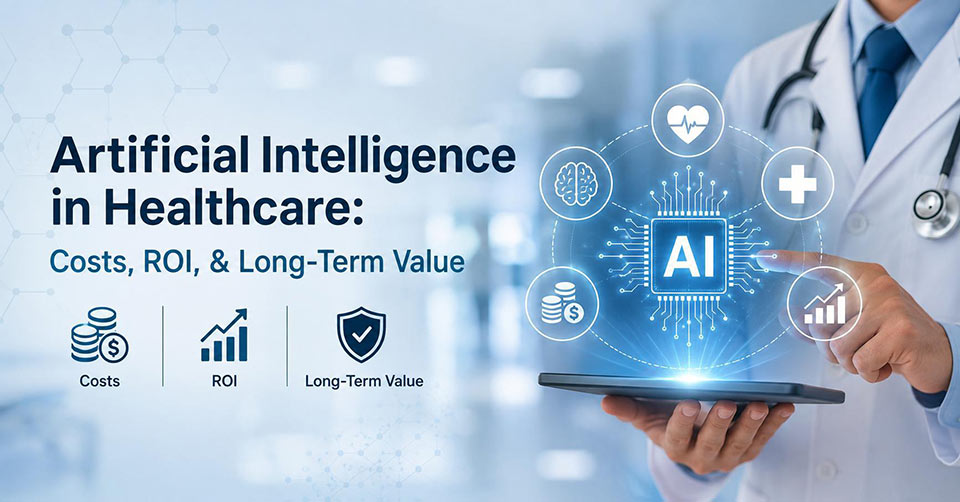
Facing tighter budgets and increasing operational complexity, healthcare providers are increasingly adopting AI in healthcare to reduce inefficiencies, anticipate risks, and improve real time decision making. This transition strengthens ROI, reduces system pressure, and creates adaptive environments that steadily improve outcomes while maintaining cost control.
How AI in Healthcare Is Bridging Gaps in Modern Medicine
The pace of change AI in healthcare is accelerating, fueled by AI innovations that enhance performance and patient care quality.
- Advanced algorithms to spot warning signs in patient data before symptoms become severe or noticeable.
- Deeper insights from radiology scans, improving the detection and understanding of complex health conditions.
- Treatments that align with each patient’s unique health profile for better outcomes.
- Healthcare operations and processes get efficient with automation.
- Predictive data analysis.
- Discovery processes improved through advanced analytics and modeling.
- Clinicians make informed choices using comprehensive data analysis.
- Ongoing patient oversight is possible using connected devices and platforms.
The Real Cost of Adopting AI Across Healthcare Systems and Patient Care
Deploying AI across healthcare systems and patient care increases efficiency and outcomes but necessitates considerable initial and lasting investment costs.
Costs of AI Technology Implementation
Investment in AI solutions is not fixed and depends on the level of complexity, scale, and customization involved. Organizations choosing between ready to deploy tools and bespoke systems should carefully balance initial costs with long-term operational expenses for sustained value.
| Category | Description | Estimated Cost |
|---|---|---|
| Pre-Built Diagnostic Tools | Subscription based solutions designed for immediate use in areas like imaging or clinical support with minimal setup required | $50,000 to $500,000 per year |
| Enterprise AI Platforms | Comprehensive systems that integrate across departments, offering advanced analytics, automation, and scalability | $200,000 to $2,000,000 per year |
| Custom Model Development | Fully tailored AI solutions built to match specific organizational needs, requiring development, testing, and ongoing maintenance | $500,000 to $5,000,000 or more |
Beyond the Surface: The Hidden Costs
Many organizations overlook ongoing operational, regulatory, and workforce challenges that gradually increase overall implementation expenses over time.
Workflow and System Alignment Issues
Integrating AI into existing clinical workflows and records systems is often complex, requiring significant customization, coordination, and ongoing adjustments.
Compliance and Certification Challenges
Ensuring compliance through certifications and clinical safety validation creates additional regulatory hurdles that add time, complexity, and substantial cost to AI adoption.
Data Protection and Regulatory Security
Keeping patient data secure and compliant requires continuous safeguards and system updates, increasing both operational complexity and long-term costs.
Supporting Staff Adoption Efforts
Encouraging workforce engagement and providing structured training enhances usability and outcomes, while increasing implementation effort and cost.
Continuous System Improvements
Ongoing data updates are needed to maintain system performance and relevance, adding sustained technical effort and cost pressures.
Assessing Returns from AI Investments in Healthcare
While upfront investment may be high, many organizations are now realizing clear returns within three to five years through efficiency improvements, revenue growth, and better patient outcomes across different functions.
1. Administrative Efficiency
A large part of the value comes from improving day to day administrative work. Clinical documentation tools and EMR software solutions can save providers up to 10 hours per week, which often leads to a 25 to 30 percent increase in patient capacity.
Errors in billing and claims also drop as processes become more automated. Payments move faster, and there is less time spent fixing mistakes. Scheduling improves as well, with systems reducing missed appointments by 20 to 35 percent, which helps make better use of available time.
2. Better Outcomes
Improved care quality also leads to stronger financial returns over time. Predictive systems detect patients more likely to be readmitted, reducing readmission rates by 15 to 30 percent. Since each avoided case saves about $15,000 to $25,000, the financial impact is quickly felt.
Early detection tools also accelerate diagnosis and treatment. This can reduce intensive care requirements and shorten hospital stays. The effects build over time, with cost savings and better outcomes moving in the same direction.
3. Faster Research and New Revenue Opportunities
The impact reaches beyond AI in healthcare delivery. In research, advanced systems can cut down drug discovery and clinical trial timelines, sometimes quite significantly.
As part of this process, improved trial design and better patient matching help minimize delays, bringing treatments to market faster and creating additional revenue opportunities. These returns take longer to appear but are typically larger overall.
A More Realistic View of ROI
The return is more than just cost reduction. It comes from a mix of lower expenses, smoother operations, and new revenue potential. In fact, a 2025 industry report shows that roughly 73 percent of healthcare leaders are already seeing measurable returns from production level deployments. And this figure is believed to be increasing as implementation scales.
Another important factor is how implementation is handled. Systems that are integrated into day to day workflows usually perform better than those tested only through isolated pilots. While it sounds straightforward, it often determines real world success.
Future Value and Impact
Medical and biometric data will play a growing role in identifying health risks earlier, allowing quicker intervention and reducing the chances of serious complications and long run care costs. At the same time, machine learning will improve treatment precision by analyzing genetics, lifestyle, and global clinical insights.
AI will also speed up drug discovery by evaluating compounds faster and predicting outcomes more efficiently, making development timelines shorter and more cost effective. In addition, diagnostics and workflows will improve, supporting earlier detection and reducing administrative burden.
Conclusion
AI in healthcare continues to influence both clinical and operational processes. With platforms such as EMR software solutions helping structure data, organizations can work more efficiently and make informed decisions. The direction is slowly moving toward predictive care and more stable long-term performance.
Frequently Asked Questions
What is artificial intelligence in healthcare?
AI in Healthcare uses algorithms to analyze data, improve decisions, and enhance patient care.
Is there an AI for health?
Yes, AI tools assist in diagnosis, treatment planning, and patient monitoring across healthcare systems.
Is there a medical AI like ChatGPT?
Yes, medical AI assistants like Buoy Health, IBM Watson Health, and Ada Health help with clinical guidance.
How is AI used in medical healthcare?
AI is used for diagnostics, imaging analysis, predictive care, workflow automation, and drug discovery.
What are the top 4 AI tools in healthcare?
Top AI tools include Microsoft DAX Copilot, Tempus AI, Aidoc, and PathAI for clinical efficiency and diagnostics.